The Complete Small Business Website Planning Guide
Work through your pages, content, budget and timings before you start talking about design.
Read the guide → 22 minutesPDF ↓
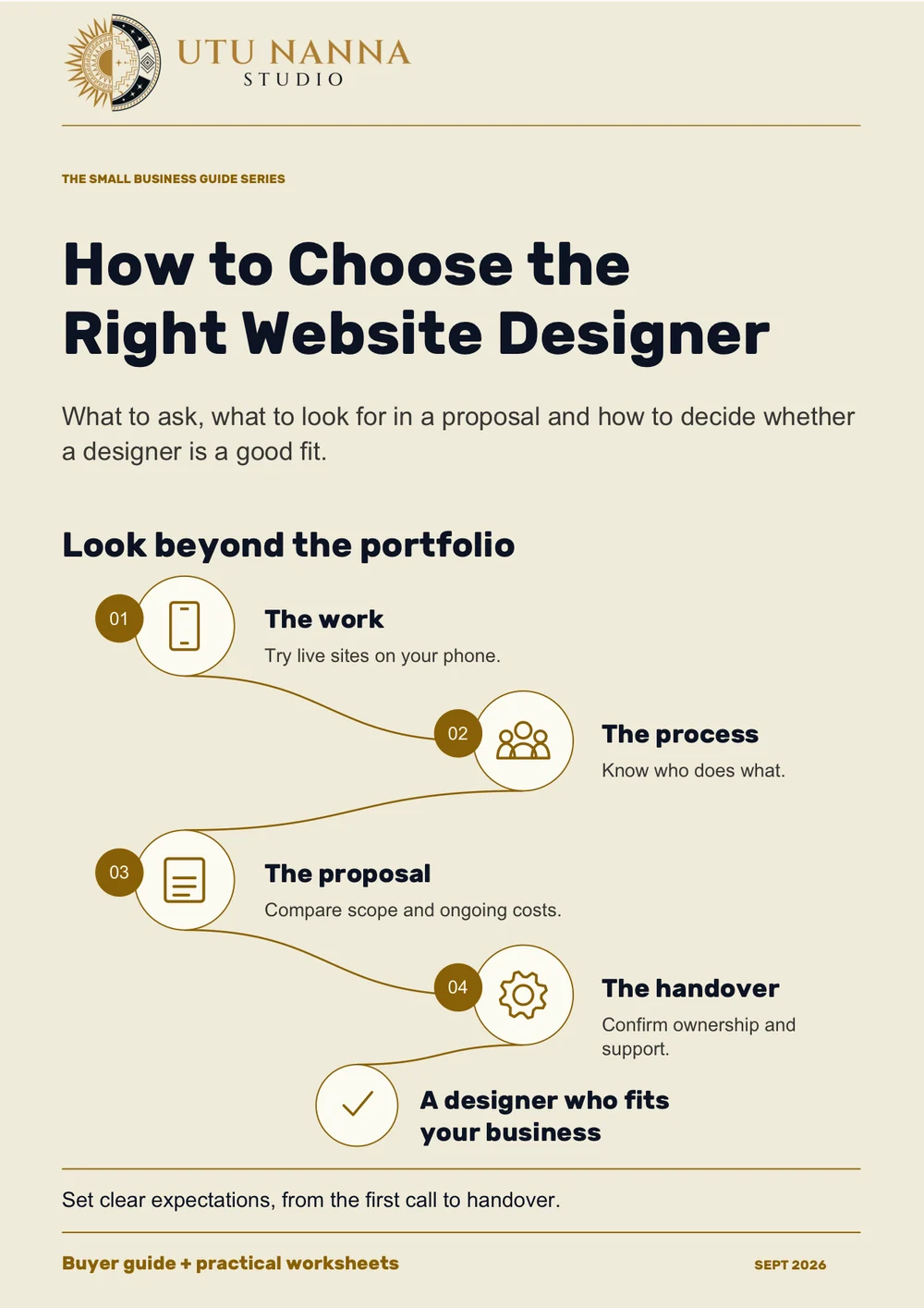
What to ask, what to look for in a proposal and how to decide whether a designer is a good fit.
26 pagesSeptember 2026 edition23 minutes to read
Free · PDF · 26 pages · 262 KB
Choosing a website designer can feel strangely difficult. Every provider uses a different process. Proposals rarely include the same things. Portfolios show polished final screens but reveal almost nothing about the meetings, missed deadlines, business results, or post-launch support behind them.
Price does not solve the comparison. A $3,000 quote and a $15,000 quote may represent similar work at different rates—or completely different levels of strategy, writing, customization, and responsibility.
The right choice is not always the most celebrated studio or the cheapest capable freelancer. It is the partner whose skills, process, scope, and communication match the problem your business actually needs to solve.
This guide will help you define that problem, compare providers fairly, ask revealing questions, understand ownership and maintenance, and recognize warning signs before a contract is signed.

Do not begin with a list of designers. Begin with a short internal brief. The website planning guide walks through each item below in more depth.
Write down:
You do not need every answer. A capable partner can help discover them. You do need enough clarity to avoid comparing a template setup with a full strategic engagement as though they are the same product.
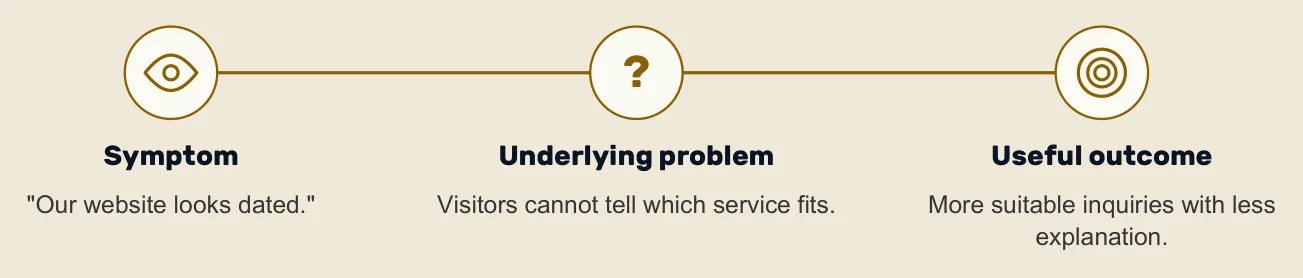
“The website looks dated” may be true, but it may not be the central issue. The deeper problem could be unclear positioning, poor lead quality, an inflexible platform, missing service content, or a business that has changed dramatically.
Ask what would remain wrong if the website looked modern tomorrow. That answer helps identify the expertise you need. A website redesign worth paying for starts from that answer rather than from the visuals. For the problems that usually sit underneath a dated look, read why most small business websites never generate leads.
The boundaries overlap, but most options fall into a few categories.
Best for a simple, lower-risk need when the business has more time than budget. The owner remains the strategist, writer, editor, tester, and project manager. Why AI can't replace a good website designer covers where these tools stop.
One person may handle strategy, design, development, and sometimes copy. This offers direct communication and efficiency, but depth varies by discipline and capacity depends on one person.
A specialist may focus on brand, conversion copy, UX, development, ecommerce, or SEO. This is useful when the business can manage several contributors or already has other disciplines covered.
A studio usually offers a coordinated group of disciplines with more direct senior involvement than a large agency. It can be a strong fit for small and mid-sized businesses that want strategic attention and a managed process.
An agency may provide research, branding, content, design, development, marketing, and ongoing support. This is useful for larger scope and stakeholder complexity, though the business should confirm who will actually perform the work after the sales process.
When the project involves complex accounts, workflows, integrations, or custom software, engineering depth may matter more than traditional marketing-site design. Product strategy, security, testing, and long-term maintenance become central. Smaller versions of this—a booking flow, a calculator, a comparison—can sit inside a marketing site as custom tools.
The provider's title is less important than the people, responsibilities, and process named in the proposal. For transparency: Utu Nanna Studio is a one-person studio, so it sits between the freelancer and small-studio descriptions above.
A portfolio is evidence of visual capability, not proof of the full engagement.
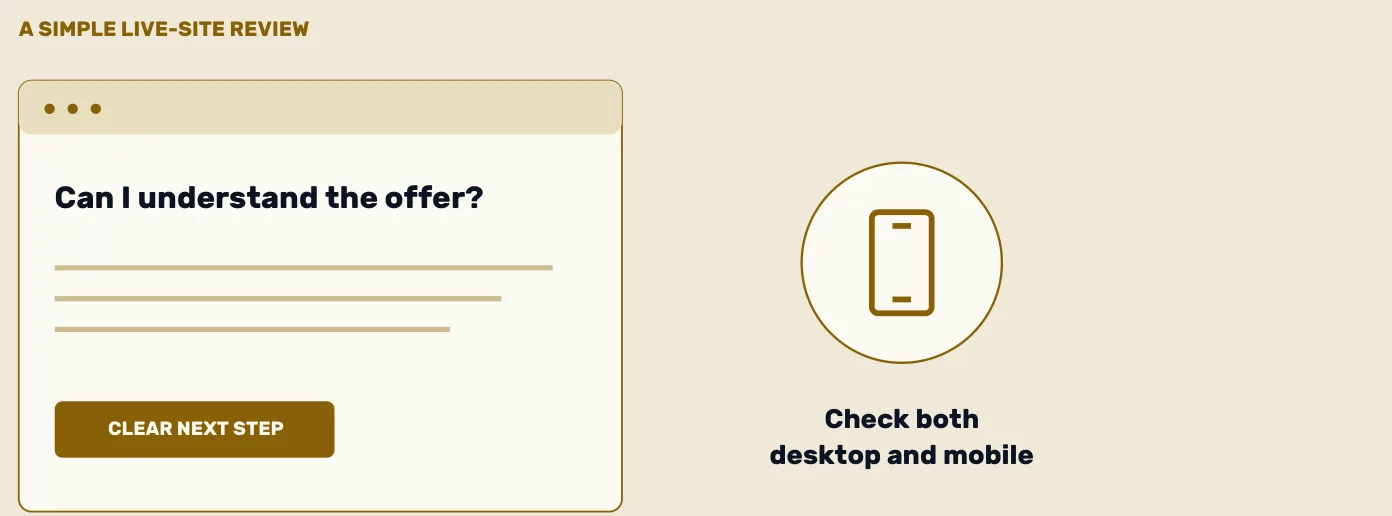
Screenshots hide mobile behavior, loading speed, forms, accessibility, content quality, and what happens when the viewport changes. Open recent work on a phone and desktop. The studio's recent work is there to be tested the same way.
Check whether you can:
If every site uses the same layout, that may reflect an efficient productized service—or a limited ability to adapt. Either can be acceptable if it matches what you are buying.
The most revealing case studies explain:
Be cautious when a provider takes full credit for work completed by a larger team. Ask which parts they personally handled.
Experience in your industry can shorten the learning curve. It can also lead to familiar solutions. A provider without a direct industry example may still be a strong fit if they demonstrate rigorous research and have solved a comparable business problem.
The question is not only “Have you designed for a dentist?” It is “Have you handled trust-heavy services, multiple locations, online scheduling, and regulated claims?”
Strong design begins with understanding. Ask what the provider needs to learn before recommending pages or layouts.
A thoughtful discovery process may include:
The depth should match the size of the project. A five-page site for a new solo business does not need enterprise research. It still needs more than “send your logo and three websites you like.”
Good answers describe a method. Weak answers jump immediately to colors and inspiration.

Content delays more website projects than design.
Ask whether the proposal includes:
“Copy support” can mean anything from a worksheet to complete writing. Get the meaning in writing.
Business owners know the subject, but knowledge does not create calendar space. If the project depends on you drafting twenty pages between client work, add time or budget for help.
A strong copy process extracts expertise from the business and shapes it around customer decisions. It should not fabricate claims or fill layouts with generic language.
Design preference matters because the website represents the brand. It should not be the only decision rule.
Ask how the designer connects choices to:
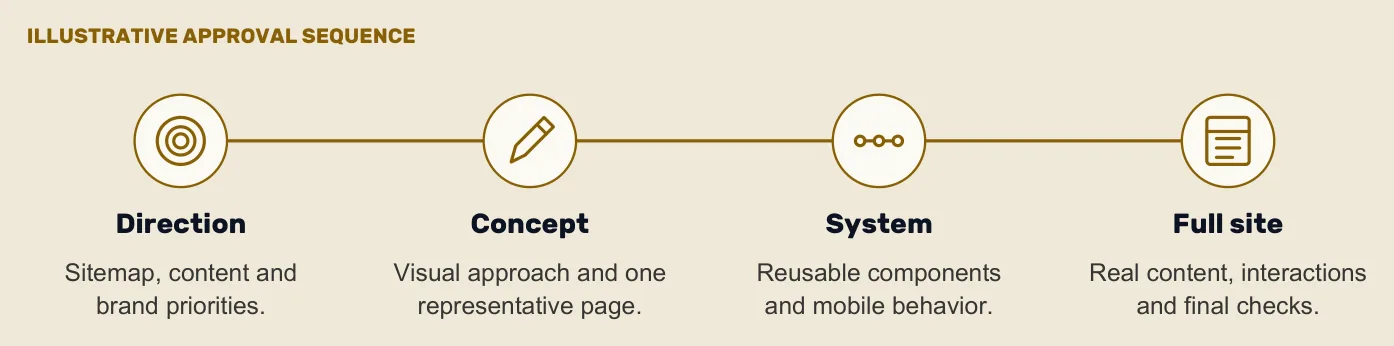
Find out what you will review and in what order. A healthy sequence might approve a sitemap, content direction, visual concept, representative page, and reusable system before every page is produced.
Ask how feedback is collected and how many revision rounds are included. “Unlimited revisions” sounds reassuring but can hide an undisciplined process or exclusions.
A designer should be able to explain the intent behind important choices without hiding behind taste or jargon. You do not need to agree with every recommendation, but you should understand the reasoning.
The website must keep working after the launch photos are posted.
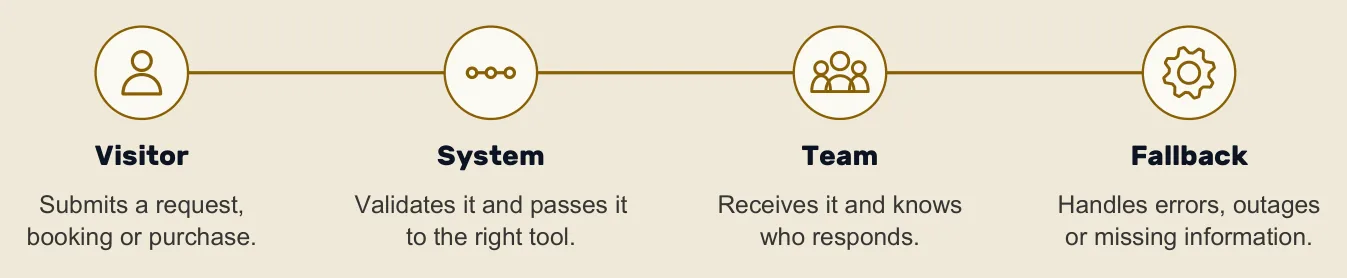
Ask:
Do not choose solely because the provider uses one platform for every project. A standardized stack can improve quality and support, but the provider should explain the fit and limitations.
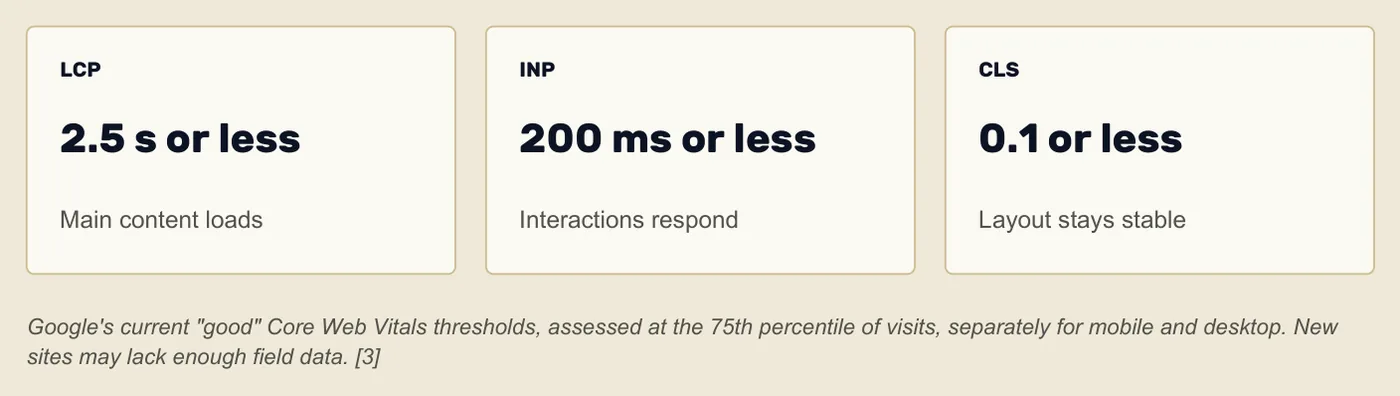
Ask how the team handles image optimization, fonts, video, scripts, caching, responsive assets, and third-party embeds. Request examples of live work, and test them on a normal connection.
No honest provider can promise identical speed scores forever. They can describe budgets, testing, tradeoffs, and maintenance.
The proposal should define the supported environments and quality-assurance process. Ask whether forms, integrations, menus, ecommerce, and key journeys are tested in the live environment.
Responsibility varies by platform. Clarify updates, backups, restoration, monitoring, certificates, administrator access, and incident response. Find out who is contacted when something goes wrong.
Accessibility affects content, design, and development. It should not appear for the first time in a launch checklist.
Ask how the provider handles:
Be cautious with a provider who says an overlay or widget “makes the site compliant.” Automated products cannot repair every barrier or replace thoughtful implementation and testing. A provider who publishes their own accessibility statement has at least thought about what they are committing to.
If your business has specific legal obligations, obtain advice from a qualified professional. The designer should be able to support the required technical work without acting as your attorney.
“SEO-friendly” is too vague to compare.
Foundational website SEO may include:
Ongoing SEO may include content strategy, digital PR, local profile work, link earning, reporting, testing, and continuous technical improvement. What the studio includes in a build is listed under SEO foundations; for a local business, the Local SEO guide sets out what the profile and review work involves.
Avoid guarantees of first-place rankings. Search engines—not agencies—control results. A credible provider can commit to sound work and transparent measurement.
A timeline should show more than a launch date. It should identify phases, dependencies, client responsibilities, review windows, and what happens when feedback is late.
Ask:
Notice whether the provider listens, answers the actual question, explains tradeoffs, and follows through. The sales process is usually the most attentive stage. If communication is already confusing, it rarely becomes clearer under deadline.

Create a comparison table. Include:
| Area | Provider A | Provider B | Provider C |
|---|---|---|---|
| Strategy and research | |||
| Sitemap and content planning | |||
| Copywriting | |||
| Brand work | |||
| Custom or template design | |||
| Number of unique pages/types | |||
| Development and integrations | |||
| SEO foundation | |||
| Accessibility work | |||
| Analytics and tracking | |||
| Content migration/entry | |||
| Training and documentation | |||
| Post-launch support | |||
| Ongoing fees | |||
| Ownership and portability |
A lower quote may expect the client to provide final copy, images, SEO strategy, and content entry. A higher quote may include specialists for each. Neither structure is automatically wrong; hidden assumptions are the problem. How much a website really costs in 2026 breaks down where the money goes in each.
Common structures include a deposit with milestones, monthly payments during the project, or a productized flat fee. Review cancellation, late payment, restart, and scope-change terms.
Do not pay the full fee in advance without a compelling reason and strong protections. Equally, expect a reputable provider to require commitment before reserving substantial capacity.
Ownership questions are easiest to resolve before the project begins.
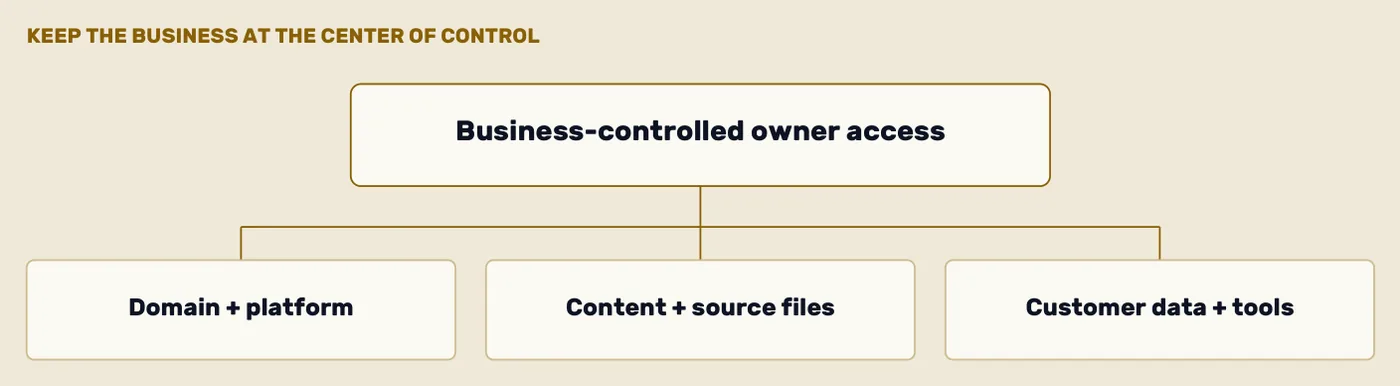
The contract should explain ownership or license rights for:
Custom copy may transfer to the business. A font, stock photograph, plugin, or platform usually remains licensed under specific terms. Some custom code may incorporate open-source libraries.
Ask what happens to each license if the provider relationship ends.
Whenever practical, the business should be the owner of the domain, analytics, search tools, primary platform, and business profiles. The provider can receive appropriate access.
Document credentials securely and use multifactor authentication. Do not let the only administrator account belong to a former employee or vendor.
A contract is not a sign of distrust. It is the shared memory of the project.
Review:
Have a qualified attorney review agreements when the project value or risk justifies it. This guide is not legal advice.
Ask what the website needs every month, quarter, and year.
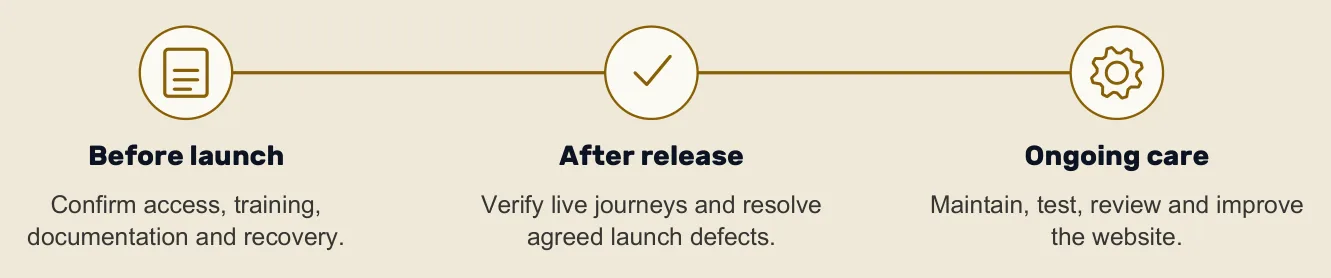
Possible responsibilities include:
“Support included” may mean email answers for two weeks or a continuing care plan. Ask:
The right maintenance model depends on how often the site changes and how costly downtime would be. What happens after your website goes live describes the first months; a website care plan is one model for the years after.
Ask recent clients questions the provider cannot answer for themselves:
References offered by a provider will naturally be positive. Listen for detail, not perfection.
A provider can discuss likely options early. A fixed prescription after a ten-minute call suggests the process is built around what they sell, not what you need.
“Premium SEO,” “full optimization,” “unlimited support,” and “custom design” need definitions.
Providers do not control search algorithms, competitors, market demand, or your sales follow-up. Guarantees may signal risky tactics or misleading sales.
If the answer to “Who owns the domain and website?” is evasive, stop. Critical business assets should not become leverage in a vendor dispute.
These are not luxury extras. The depth varies by project, but every professional process should address them.
“Just send the copy when it is ready” is a major schedule risk. Someone must own content structure, production, approval, and entry.
This may be acceptable for a transparent template package. It is a problem when sold as deeply custom strategy.
Repeated missed meetings, unexplained delays, and unclear answers are evidence. Believe the process you are experiencing.
Real capacity limits and proposal expirations are normal. High-pressure discounts, fear-based SEO claims, or refusal to let you review terms are not.
Rate each provider from one to five on:
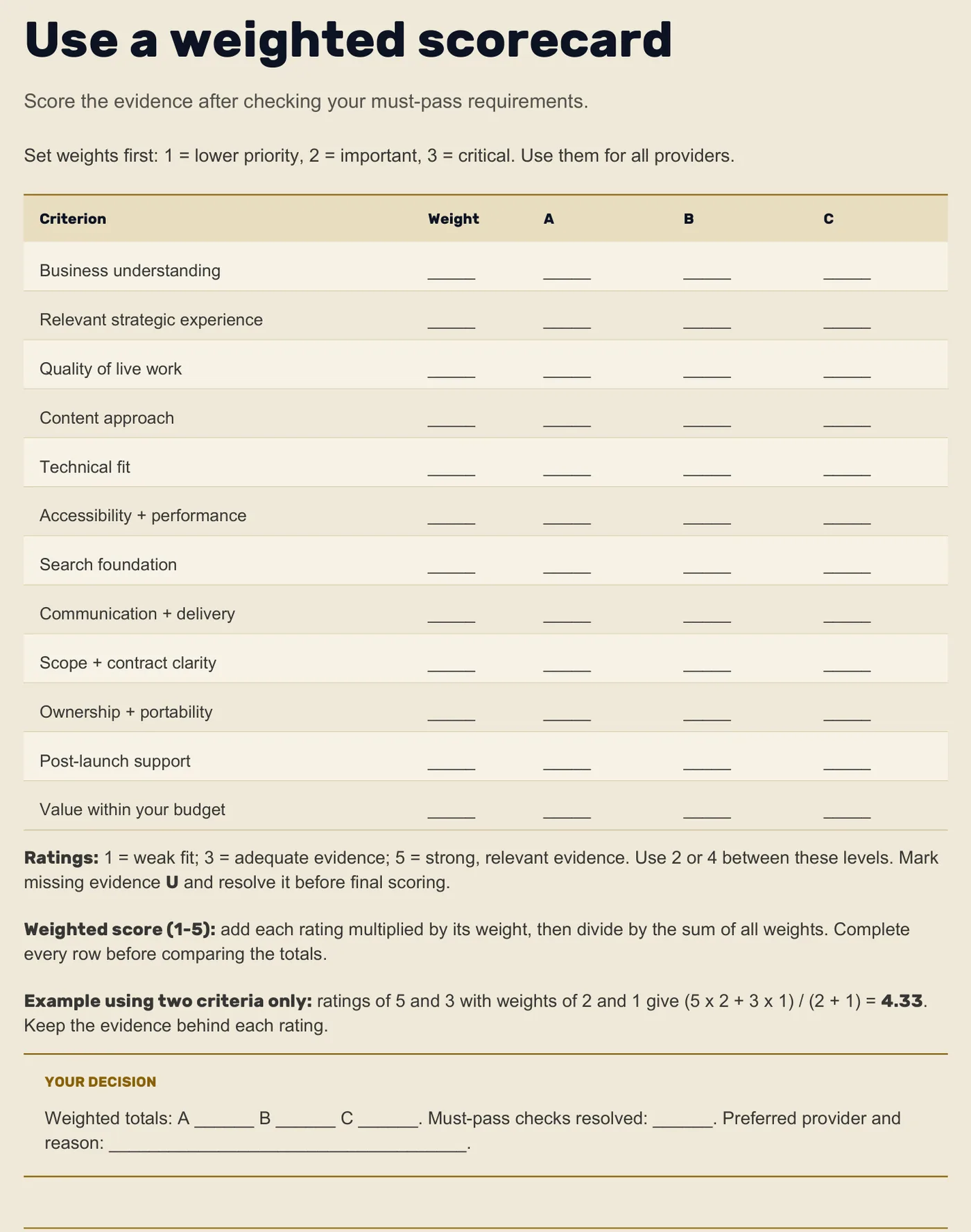
Weight the categories based on risk. An ecommerce company may prioritize technical reliability and support. A consulting firm may prioritize positioning and copy. A local service business may place more weight on local SEO and lead flow.
Do not let a charming sales call erase a weak contract, or let one portfolio style outweigh a process that clearly fits the business.
Small business projects range from hundreds for a basic setup to tens of thousands for strategy, custom content, design, development, and integrations. Compare the work and responsibility included. A price without scope is not meaningful. See how much a website really costs in 2026 for typical ranges.
Hire for fit. A freelancer may offer direct access and deep expertise; an agency may provide broader capacity and specialist disciplines. Evaluate the actual people, process, availability, and accountability assigned to your project.
Not necessarily. Remote collaboration works well for many projects. A local partner can be valuable for in-person workshops, on-site photography, community knowledge, or a business with strong local-market needs. The studio works with businesses in Babcock Ranch and across Southwest Florida in person, and with clients elsewhere remotely.
Two or three well-qualified proposals are usually more useful than ten random quotes. Speak with providers whose work, services, and likely budget range already appear compatible.
They can, if responsibilities, price, support, backups, ownership, and exit options are clear. Make sure the business retains appropriate control and can move the site or data under the contract.
At minimum, understand and document control of the domain, key accounts, content, customer data, analytics, and the rights to use the design and code. Third-party assets will often be licensed rather than owned.
A good process reduces this risk through discovery, content planning, and early visual direction. The contract should define review stages and revisions. Give feedback tied to audience, goals, and content rather than asking only for subjective changes.
You are not hiring a gallery of finished homepages. You are hiring the people and process that will turn incomplete information, competing priorities, and technical details into a working business asset.
The right partner should make the project clearer before making it prettier. They should ask useful questions, explain tradeoffs, document responsibility, and leave the business with control of what it paid to build.
If that is the kind of website relationship you are looking for, read how a website design project runs at the studio, then start a conversation with Utu Nanna Studio. We will help you define the right scope—even when the honest recommendation is to begin smaller.
The same guide, laid out for 26 pages of A4 with the worksheets you can print and write on. No email address, no sign-up.
Download the buyer guide PDF →PDF · 26 pages · 262 KB
The rest of the series
Work through your pages, content, budget and timings before you start talking about design.
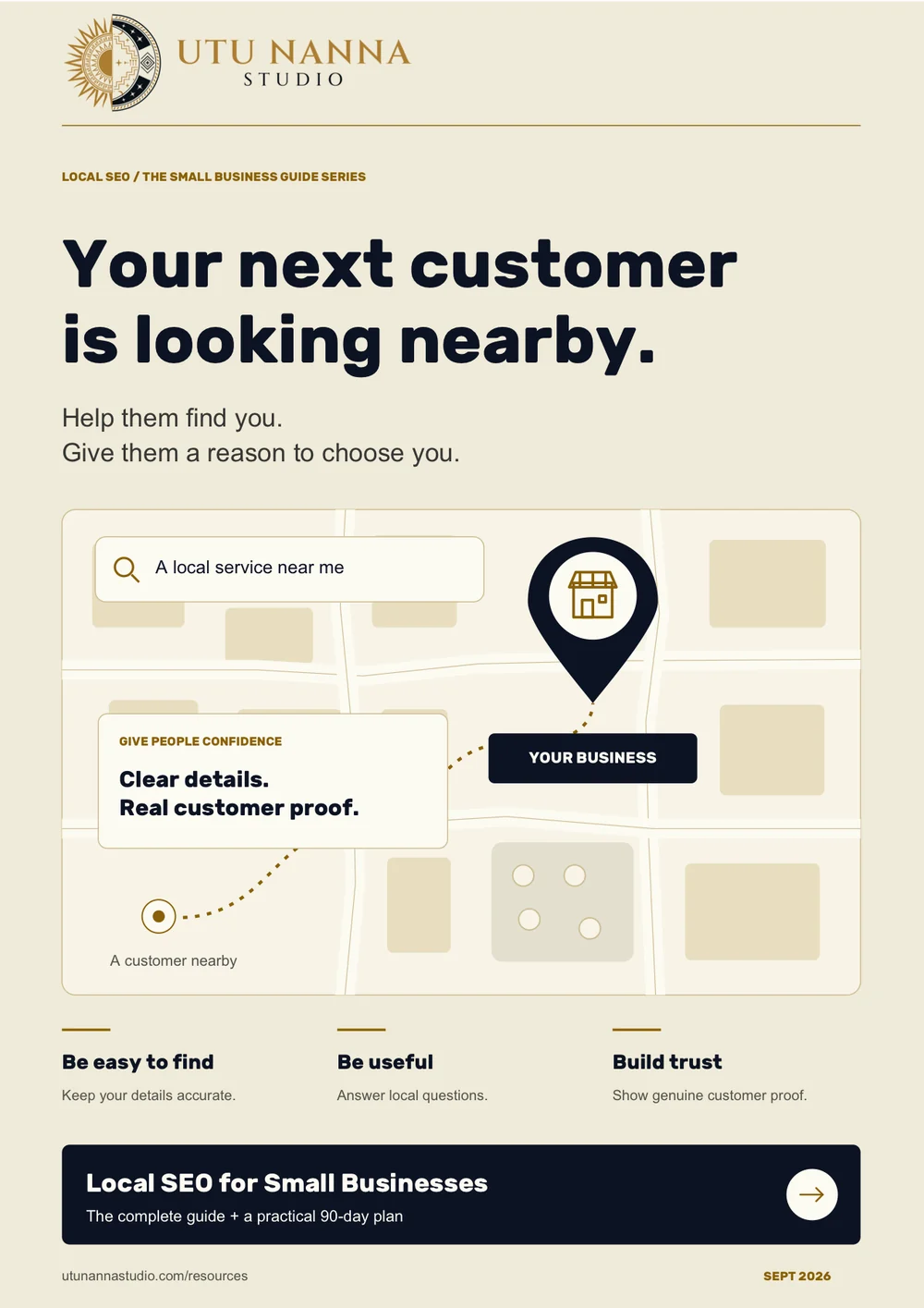
Local SEO helps nearby customers find and evaluate a business. This guide covers the systems that matter—without shortcuts, keyword stuffing, or fake location pages.
23 minutes · Written by Leah Norridge · Published
I score any site against the same 100 points and send you the findings, whether or not you ever hire me.
A few lines about your business are enough to start. We’ll talk through what you need, and I’ll put the scope and price in writing before any work begins.