Why AI Can't Replace a Good Website Designer
AI can help with writing and building a website. Here’s where I find it useful, and where a person still needs to understand the business and make the decisions.
AI can draft a homepage before your coffee gets cold. It can propose a color palette, generate an image, write code, rearrange a layout, and produce twenty versions of a call to action.
That is genuinely useful.
It is also not the same as designing the right website.
The conversation about AI and web design often gets trapped between two exaggerated positions: AI will replace every creative professional, or AI has no place in serious work. Neither reflects what is happening. Capable designers already use AI to explore, summarize, test, and produce faster. At the same time, businesses still need people to understand the problem, make consequential choices, and take responsibility for the result.
The difference is simple: AI can generate options. A good designer knows which problem those options are supposed to solve.
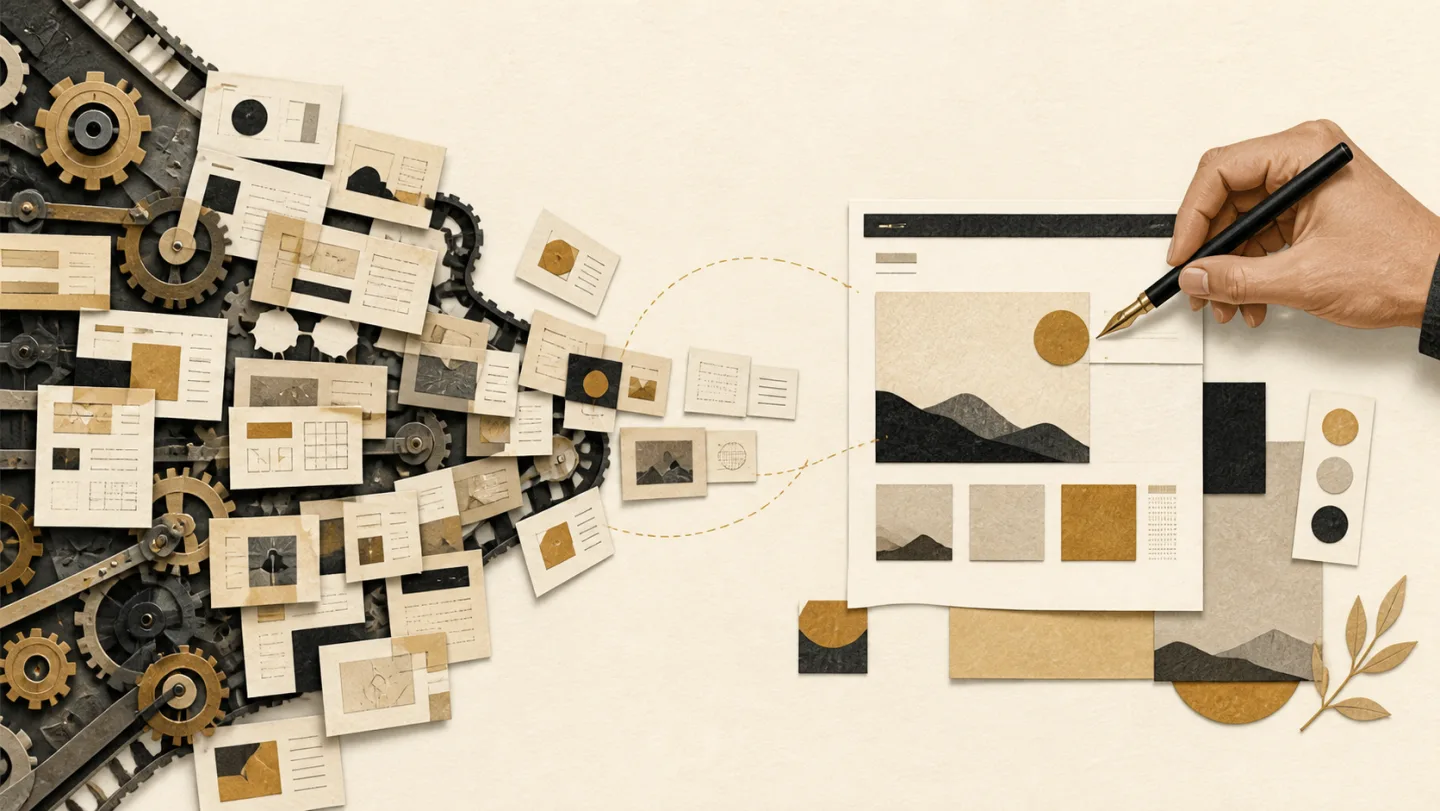
AI does not begin with your customers
An AI website builder begins with what you type into it. If the prompt is based on weak assumptions, the result will be a polished version of those assumptions.
A strategic designer begins earlier. They ask questions such as:
- Which customers are most valuable to the business?
- What brings those people to the website?
- What are they worried about before they make contact?
- Which alternatives are they comparing?
- What proof changes their mind?
- Where does the current sales process stall?
- What should a qualified prospect do next?
Those answers may come from customer interviews, sales calls, analytics, search data, reviews, competitive research, and direct conversations with the business owner. The website grows from evidence rather than a generic description of the company.
AI can help organize research. It cannot independently decide which people should be interviewed, notice the hesitation behind an answer, or reconcile what a business says with what its customers actually value.
AI cannot choose your positioning for you
Positioning is a business decision. It defines who the offer is for, which problem matters most, what makes the approach different, and why a buyer should believe the promise.
An AI tool can produce a list of possible differentiators. Many will sound plausible:
- personalized service
- innovative solutions
- quality craftsmanship
- customer-first approach
- results-driven strategy
The problem is that competitors can generate the same list.
A designer working strategically will press for specifics. What does “personalized” change in the process? Which difficult projects does the company handle especially well? Why do referrals choose this business? What is the team willing to do differently—and what are they deliberately not offering?
Strong positioning requires commitment. A tool optimized to provide more options cannot make that commitment on behalf of the company.
AI predicts language; it does not own the promise
AI-generated copy can be clear and grammatically correct. It can also be strangely weightless: full of claims, short on conviction, and interchangeable with every other website in the category.
This happens because the tool is predicting useful language from patterns. It has not delivered the service. It has not sat with an unhappy customer, refined the onboarding process, or decided what the business can confidently promise.
Good website copy depends on source material:
- Real customer language
- Specific service details
- Honest limitations
- Tangible proof
- A distinctive point of view
- An offer the business can fulfill
AI can help turn that material into drafts. It should not be asked to invent the material itself.
AI does not understand conversion in context
It is easy to tell an AI builder to “optimize for conversions.” The phrase sounds precise, but conversion is not a universal layout.
An emergency plumber, an estate-planning attorney, a wedding photographer, and a custom home builder require different decisions. One visitor may need a phone number immediately. Another needs to review a portfolio and discuss the purchase with a partner. A third needs reassurance about confidentiality before completing a form.
The right conversion path depends on urgency, risk, price, trust, sales process, and customer awareness.
A good designer maps that path. They decide how much information a person needs, where proof should appear, what the call to action should ask, and how the website hands the lead to the business. They also examine what happens after the click. A beautiful form is not effective if nobody receives the submission or the follow-up takes a week.
AI does not exercise taste consistently
Design tools can generate attractive components. The harder job is editing.
Taste is not adding more visual ideas. It is knowing what to remove, where to create restraint, when a pattern is too familiar, and which imperfect detail gives a brand character. It is maintaining coherence across hundreds of small decisions.
AI often drifts toward the statistical center: familiar layouts, expected language, fashionable gradients, safe type pairings, and images that resemble a category rather than a particular company. That can be acceptable for a quick first version. It is limiting when the business needs to be recognized and remembered.
A designer can also protect the work from the business's own impulses. They can explain why six competing buttons weaken the page, why a favorite photograph does not support the message, or why a clever headline is less useful than a direct one. That constructive resistance is part of the value.
AI can reproduce the biases and gaps in its inputs
Generated content and layouts are not automatically accurate, accessible, original, or legally safe.
Potential issues include:
- Confidently stated but incorrect claims
- Language that excludes or stereotypes an audience
- Insufficient color contrast
- Images with strange or misleading details
- Code that works in one situation but fails in another
- Missing form labels or poor keyboard behavior
- Content that resembles existing material too closely
- Invented testimonials, statistics, or credentials
- Privacy and tracking choices made without business context
Human review does not guarantee perfection. It creates accountability. Someone checks the source, tests the interaction, challenges the assumption, and decides whether the work is ready to represent the business.
AI does not manage the whole project
The final website is one output of a larger process. Someone still needs to:
- Define scope and priorities
- Gather feedback from stakeholders
- Keep content moving
- Coordinate photography or brand assets
- Choose and configure platforms
- Connect forms and business systems
- Plan redirects from the old website
- Test browsers and devices
- Set up analytics and search tools
- Train the team
- Monitor the launch
- Support the site afterward
Tools can assist with each task. They do not remove the need for ownership across the project.
When a business hires a capable designer or studio, it is buying judgment and stewardship as much as design production.
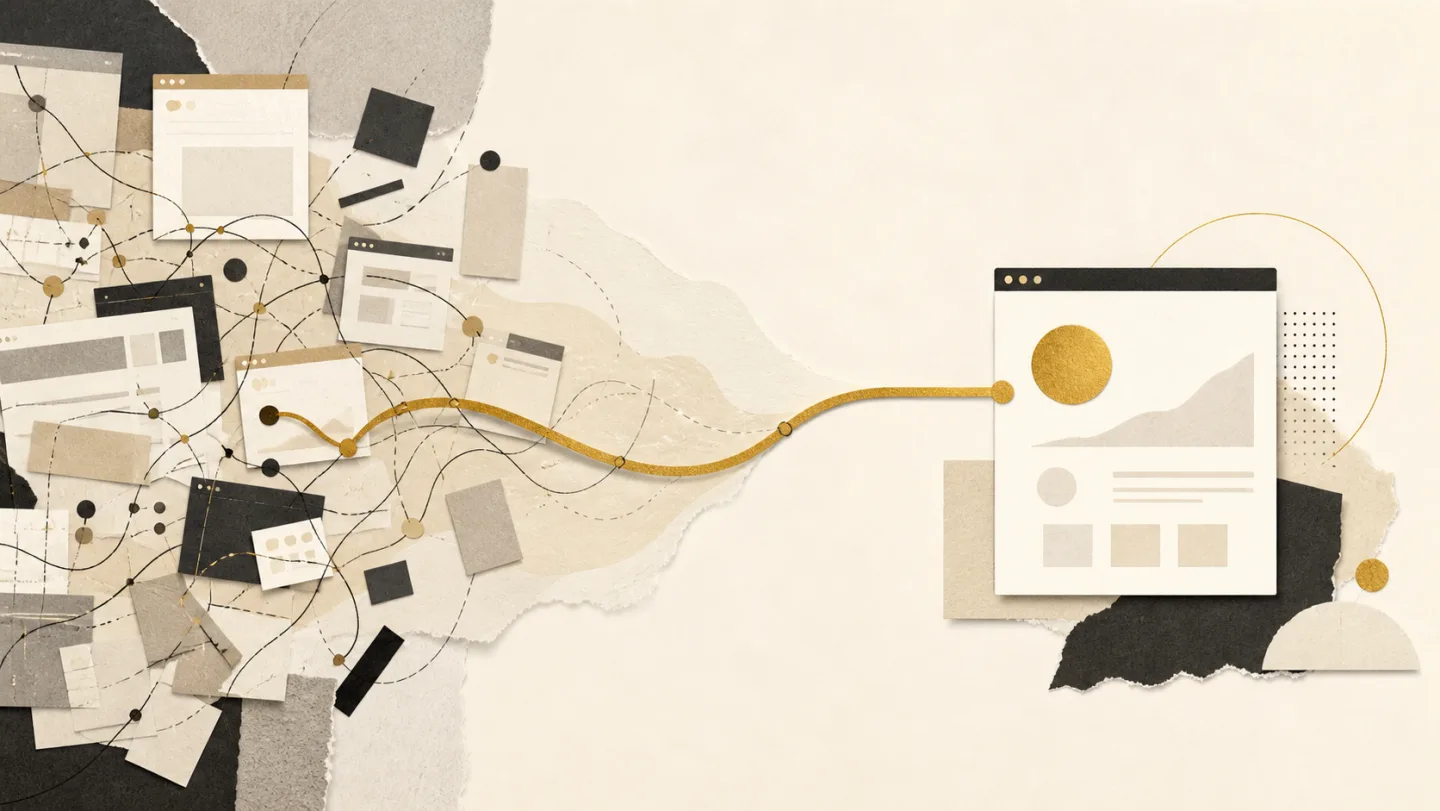
Where AI genuinely improves web design
Rejecting AI outright would be as unhelpful as treating it like an autonomous creative director. Used well, it can give designers more time for the parts of the work that require close attention.
Faster exploration
AI can produce rough directions, content structures, code experiments, and image concepts quickly. Early ideas become cheaper to test and easier to discard.
Research support
It can summarize large sets of notes, group repeated questions, identify patterns in reviews, and help a strategist see areas that deserve deeper investigation.
Drafting and variation
Writers and designers can explore alternate headlines, microcopy, content lengths, or component states without treating the first draft as precious.
Repetitive production
Image descriptions, content formatting, test data, basic code, documentation, and quality-assurance checklists can often be accelerated.
Technical troubleshooting
Experienced developers can use AI to investigate errors, write tests, or explore unfamiliar APIs. The experience matters because the output still needs to be evaluated.
At Utu Nanna Studio, we are comfortable using AI where it improves the process. We do not use it as a substitute for learning the business, understanding the customer, or taking responsibility for the finished work.
When an AI website builder may be enough
Not every business needs a custom engagement. An AI-assisted builder can be a reasonable choice when:
- You are testing a new idea.
- The budget is extremely limited.
- The website has a short useful life.
- You need a simple online presence quickly.
- The offer and audience are already clear.
- You are prepared to write, edit, test, and maintain it yourself.
The decision should reflect the cost of being wrong. If the website is mostly a credibility check for warm referrals, a simple version may do the job. If it drives high-value leads, supports a complicated sales process, or represents an established brand, strategic help becomes more valuable.
For a practical comparison of the work, time, and responsibility involved, read why a DIY website can undersell your business.
Signs that you need a human designer
Consider professional support if:
- Your site looks fine but produces poor-fit leads.
- You cannot explain what makes the business meaningfully different.
- Several audiences or services compete for attention.
- The website must connect with operational tools.
- You need customers to find you through search.
- Accessibility, privacy, or industry requirements create real risk.
- Internal stakeholders disagree about priorities.
- The project keeps stalling because nobody owns it.
- A weak launch would cost more than professional help.
The designer does not need to avoid AI. They need to be able to explain the thinking that goes beyond it.
How to evaluate an AI-enabled designer or studio
Ask process questions rather than policing tools:
- How will you learn about our customers and sales process?
- Which decisions will be based on research?
- How do you check AI-assisted content for accuracy and originality?
- Who reviews accessibility, mobile behavior, and performance?
- How do you protect confidential information?
- Can you explain why the recommended structure fits our business?
- Who is accountable when something does not work?
The answers should show a clear chain from business goal to design decision.
Frequently asked questions
Will AI replace web designers?
AI will replace some production tasks and change how designers work. It may also reduce demand for basic, undifferentiated websites. Businesses with complex offers, valuable customers, distinctive brands, or meaningful risk will still need human research, judgment, collaboration, and accountability.
Is AI-generated website copy bad for SEO?
The method of production is not the main issue. Thin, inaccurate, repetitive, or unhelpful content is a problem whether a human or AI produced it. Content should be created for a real audience, demonstrate knowledge, answer the searcher's need, and be reviewed for accuracy and usefulness.
Can AI build a custom website?
AI can generate customized layouts and code, but “custom” is not only a technical description. A truly tailored site reflects the company's positioning, customer journey, content, operational requirements, and brand. Those inputs still need careful human decisions.
Should I tell my designer not to use AI?
It is more useful to establish standards for confidentiality, originality, accuracy, ownership, and review. A designer may use AI responsibly without allowing it to make strategic decisions or publish unchecked work.
Use better tools. Keep human judgment.
AI makes creation faster. It does not make every output worth publishing.
The future of good web design is not human versus machine. It is thoughtful people using strong tools without outsourcing the responsibility to think.
If you want a website shaped around your customers—not around the default answer to a prompt—start a project with Utu Nanna Studio. We will bring the useful speed of modern tools and the strategic judgment your business still needs.
9 minutes · Written by Leah Norridge · Published
Want this looked at on your own site?
I score any site against the same 100 points and send you the findings, whether or not you ever hire me.
Tell me what you’re working on.
A few lines about your business are enough to start. We’ll talk through what you need, and I’ll put the scope and price in writing before any work begins.